


This week we immersed ourselves in crypto as we maintain the tradition of visiting THE European crypto conference - EthCC. Normally in Paris, but because of Olympics, this year in Bruxelles, 🇧🇪! It’s like a condensed, more bureaucratic Paris, with everyone walking around in blue lanyards and suits… The crypto crowds were standing out.
We enjoyed the waffles, subway, run+workout with Bankless and a custom strength session at Barbell Brussels.
🤼 People
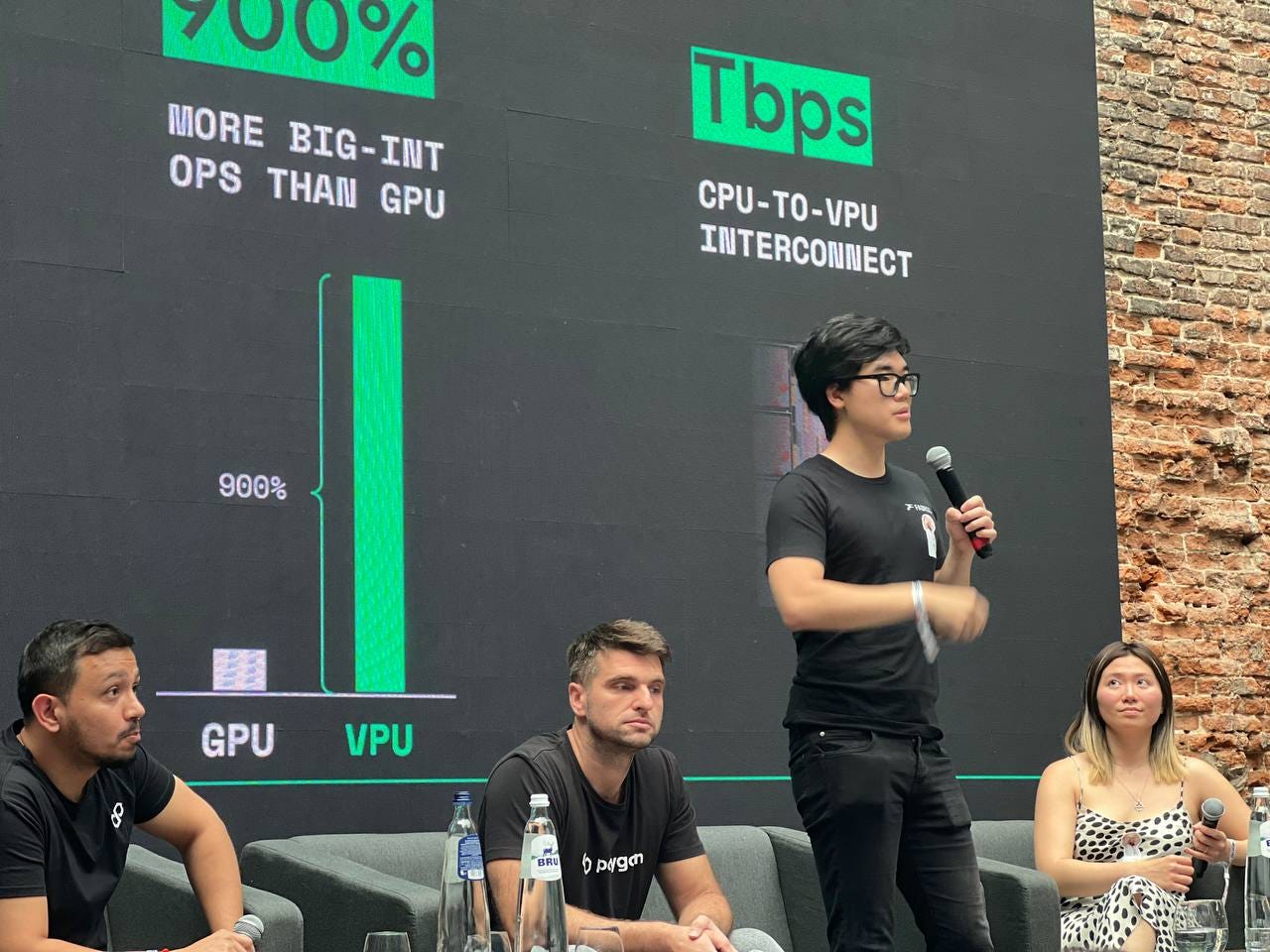
Michael and Tina - co-founders at Fabric Cryptography
We invited some very close founders and befriended VCs to connect over excellent cidre and brilliant food at Badi, in Bruxelles. In spite of the ragnarök-like rain hitting the city, almost everyone made it. We co-hosted this event with Michael and Tina in the evening of the day where their partnership with Polygon was announced at Aggday. Watch Polygon founder Sandeep make the announcement and invite M&T on stage here. Here’s the intro quote:
“A very strategic announcement led by my friend Jensen, uh I mean Michael” - Sandeep Nailwal “confusing” Fabric for NVIDIA
This is the very first logical partnership between networks (proving demand) and the fastest cryptography hardware out there (Fabric). It’s the Microsoft+Intel, Apple+ARM, Cisco+VMware of cryptography.
We’re very proud of the hard work that went into this, and the founders resilience and ambition. They continue to show us that the sky is the limit for verifiable compute.
Tomasz Stanczak - founder of Nethermind, mate at Flashbots, and many more contributions
Nethermind is maybe the most mature dev and research organization in crypto. Try and name a significant crypto project that they haven’t contributed to. Besides doing great R&D, they also run a MASSIVE intern program with a tough selection process and then large amounts of freedom and accountability. We talked to Tomasz and his closest team about the future of blockchain in an intelligence-abundant but trust-lacking world.
💼 Launch: Portfolio jobs board

We’re very happy to launch a new segment in the digest, with highlighted jobs from the portfolio! They’re all listed at our freshly minted jobs-page! Check it out.**
This weeks selection:
🚀 Companies
MakeInference - GPUs at low cost/high utilization
Status: Pre-seed
Source: CAVI
Founders:
Why it’s cool:
Running GPUs is like selling iron when the railway system was expanding. A very stable business that needs to be executed very well to be competitive. No harm in trying! Is it super innovative? Probably not. Is it groundbreaking? Yes, in the sense that it gets us closer to the $0/inference limit which is in everyone’s interest.
Harmonic - Mathematical superintelligence
Status: Seed (probably)
Source: CAVI
Founders: Tudor Achim
Why it’s cool:
The key to science (and at the base of knowledge) is mathematics. So using AI to speed up discovery in mathematics sounds like a good focus area. There’s been some recent attention in this topic with Terence Tao using computer-aided proof language Lean 4 to formalize some of his prior work, and discovering a small error in the paper along the way. First discoveries and contributions to math papers are already being done (Nature pub) and we expect at some point that the bottleneck will be human mathematicians who can interpret results well enough from the 10,000 virtual Terence Tao’s that will be around.
💡 Ideas & Science
Graphical AI systems - cool library for synthetic mapping
If we believe that we’ll run out of data and will need to solve it synthetically, it makes sense that we can represent terrain in a life-like way digitally. Novaia seems to be working on a few different libraries for this. Can’t wait.
Helsing raises €450M at €4.95B valuation and Quantum-Systems close $90M sales of ISR drones to Australia
European defense tech (Actually Munich defense tech in this case) is approaching prime levels. With some significant traction, we expect Helsing, Q-S and others like them to show the way of how to build defense unicorns in Europe.
Someone is wrong on the internet (AGI Doom edition) by Halvar Flake
This offers a very sane look at why fast take-off might not be such a concern in spite of what the internet is telling you. The main arguments are: AI will need to do real-world, advanced experiments to confirm it’s understanding of the world; and it’s still limited by information theory and can’t break the laws of physics, so won’t be as God-like as it might seem in doomer-articles. Not sure these arguments are complete as they stand, but they’re worth taking into account.